
3.3. Three-Step Evidence Grouping
The Three-Step Evidence Grouping view is designed for situations in which maximum control of confounding factors is required. This structure progressively removes sources of bias by organizing evidence in a strict hierarchical sequence, allowing clinicians and researchers to analyze outcomes under highly comparable conditions.
This approach is particularly valuable when the goal is to understand the expected outcomes of a specific IOL within a specific functional category and under a defined procedural strategy.
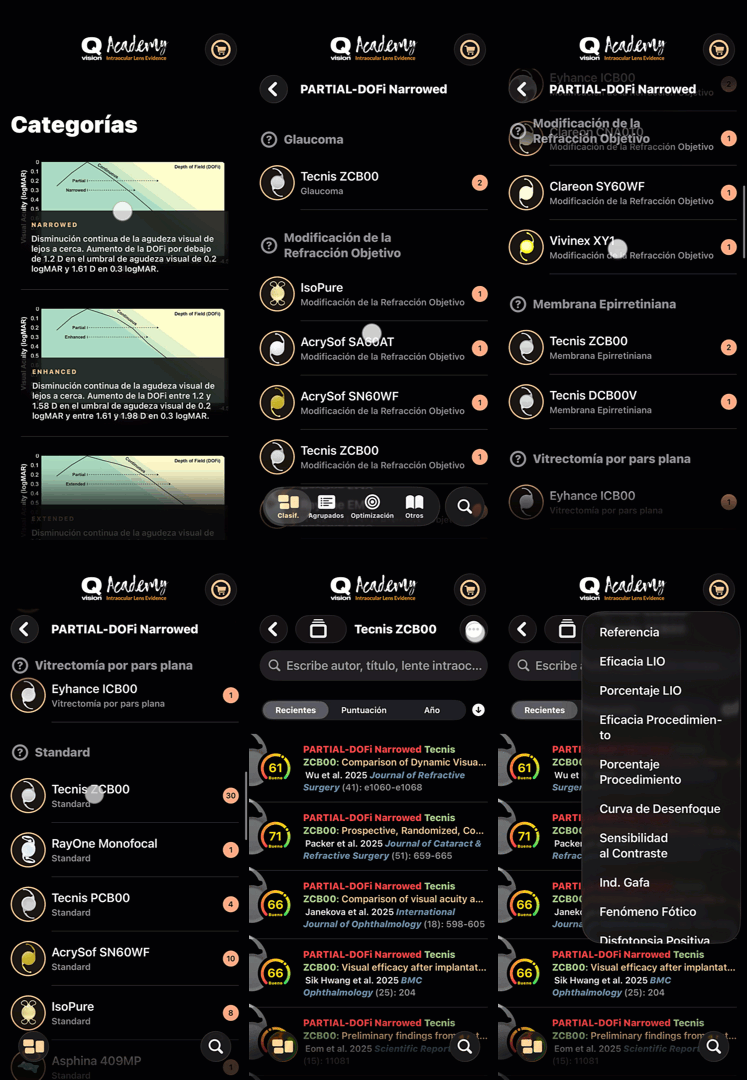 | How to access this viewThis view is accessed by tapping the Classification icon in the bottom navigation bar of the app. This entry point opens the hierarchical navigation used for controlled evidence grouping. What can be seenThis view follows a structured three-step navigation. At the first level, all Functional Classification categories are displayed. Selecting a category leads to a second level showing the intraocular lenses (IOLs) belonging to that category. Finally, selecting a specific IOL opens the third level, where all Confirmatory Reports corresponding to that IOL within the selected category are listed. This progressive navigation helps refine the evidence and facilitates focused, bias-aware analysis of clinical outcomes. |
|---|
3.3.1. When to use Three-Step Evidence Grouping
This view should be used when:
The objective is to precisely characterize the clinical performance of a particular IOL.
Comparisons must be made within the same functional category, avoiding category-driven bias.
Procedural and surgical strategy-related variability needs to be minimized.
Evidence is being prepared for formal comparison, interpretation, or meta-analysis.
In contrast to the two-step approach, this structure prioritizes methodological consistency over breadth.
3.3.2. Three-Step Navigation Workflow
The Three-Step Evidence Grouping follows a strict top-down hierarchy, where each level reduces potential sources of bias.
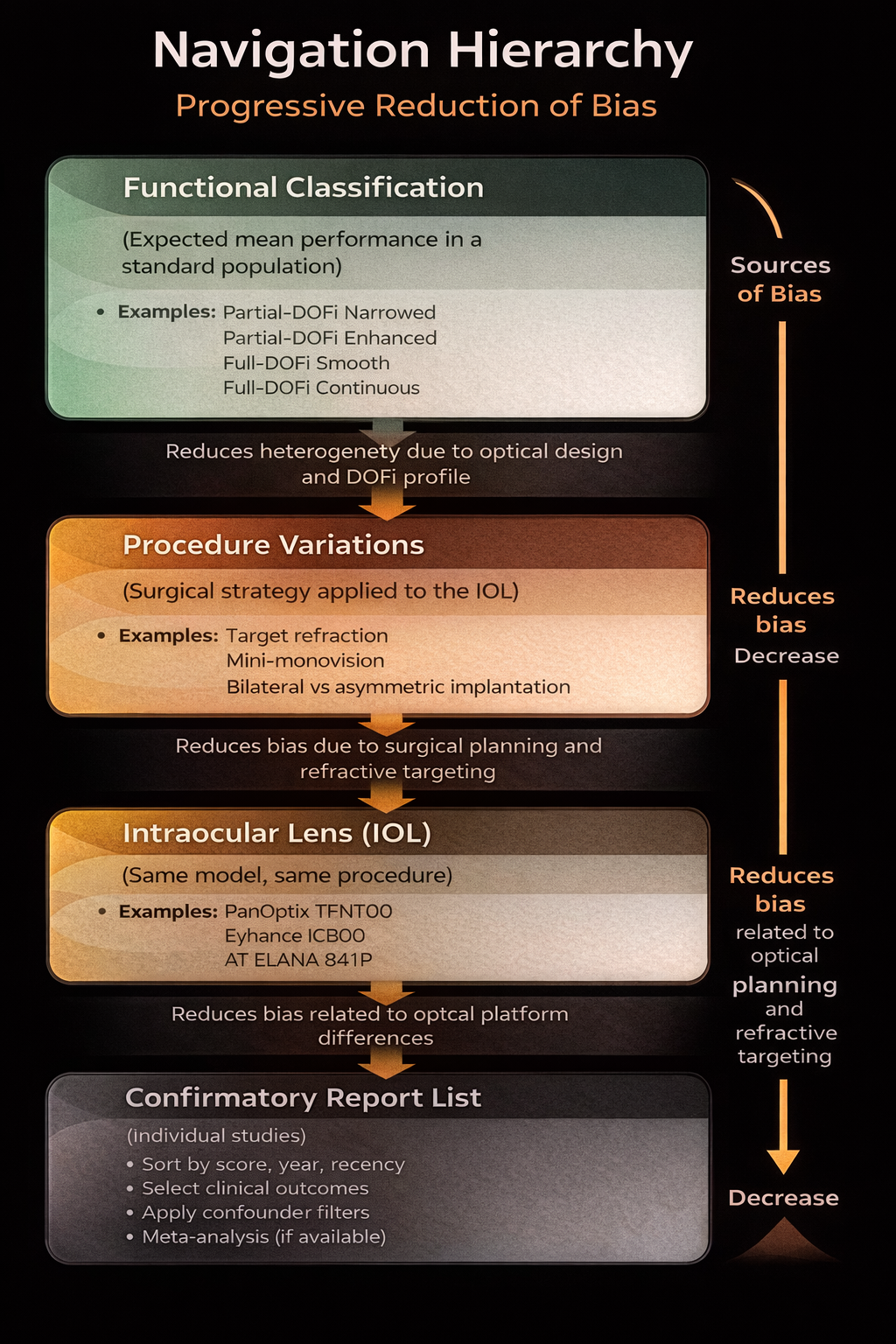
The Three-Step Evidence Grouping follows a strict top-down hierarchy, where each level reduces potential sources of bias.
3.3.2.1. First navigation level: Functional Classification
At the first level, reports are grouped by Functional Classification category. Each category includes IOLs whose mean expected performance is similar in a standard population without relevant comorbidities. This ensures that all subsequent comparisons are made within a homogeneous functional framework.
3.3.2.2. Second navigation level: Procedure Variations
After selecting a functional category, reports are further grouped by procedure variations, such as target refraction or other surgical strategies. This step isolates the effect of procedural decisions, which are known to significantly influence outcomes, and prevents mixing evidence derived from different surgical approaches.
3.3.2.3. Third navigation level: Intraocular Lenses
Within each procedure variation, reports are grouped by IOL model. At this level, studies are aligned by functional category and procedural strategy, leaving the IOL as the primary remaining variable.
This organization allows highly controlled comparison of outcomes attributable to the lens itself.
3.3.3. Final Navigation Levels: Reports and Outcomes
The final views display:
The Confirmatory Report list, where individual studies are presented and can be sorted by recency, score, or year. You can read more about working with this in articles 2.2 and 2.3.
A clinical outcome selector, allowing users to choose which outcome to visualize and compare (e.g., IOL efficacy, procedure efficacy, defocus curve, contrast sensitivity, or patient-reported outcomes).
Access to the meta-analysis option, when available, to synthesize evidence across studies.
The individual Confirmatory Report, where detailed study information and results are presented. You can know more about reading Confirmatory Reports in article 1.3.
This structured navigation ensures a logical progression from broad functional grouping to detailed study-level analysis, supporting robust interpretation and comparison of the available evidence.