
3.2. Two-Step Evidence Grouping
The Two-Step Evidence Grouping view is designed to explore evidence at an intermediate level of control, allowing users to compare outcomes while intentionally preserving certain sources of variability. This approach is especially useful when the clinical goal is to understand how different IOLs behave within the same functional context, or how a single IOL performs across heterogeneous study conditions.
Rather than fully isolating all confounders, the two-step structure enables broader comparisons that reflect real-world variability while still maintaining a coherent analytical framework.
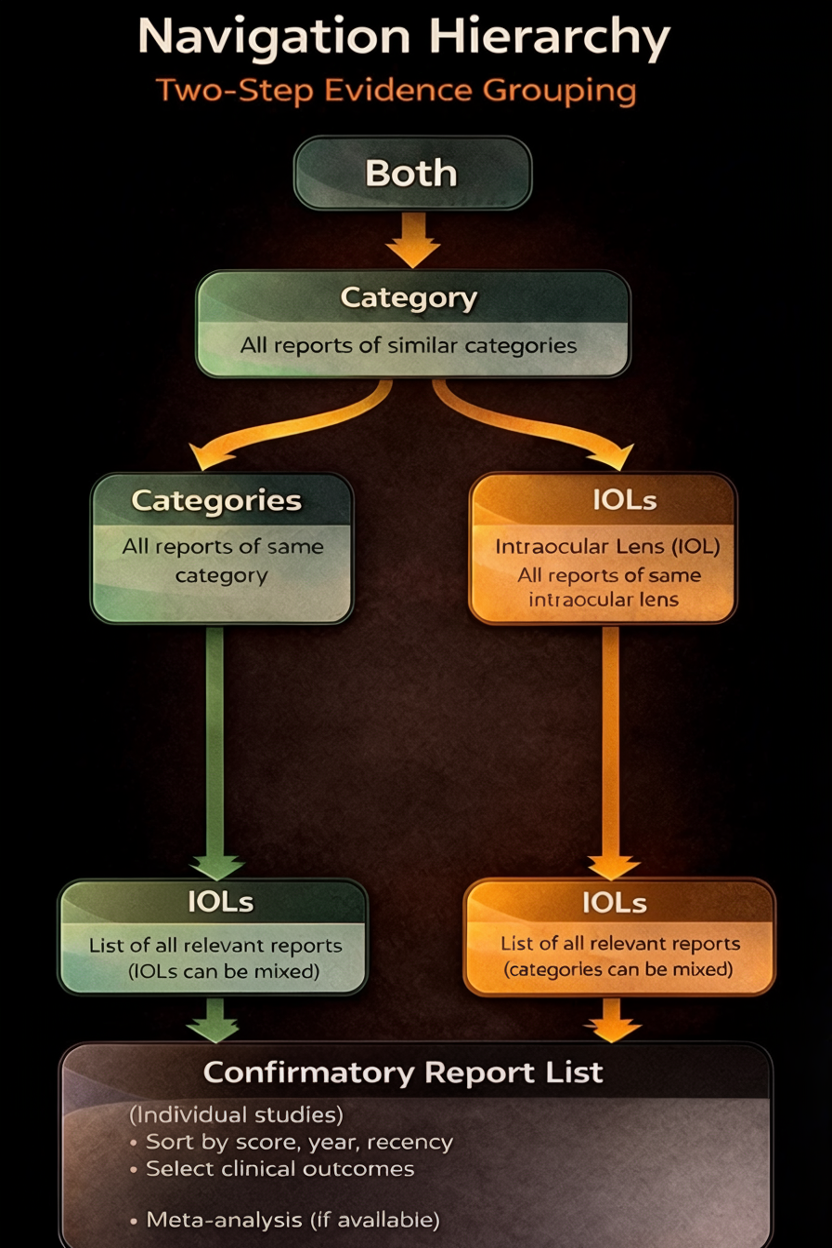
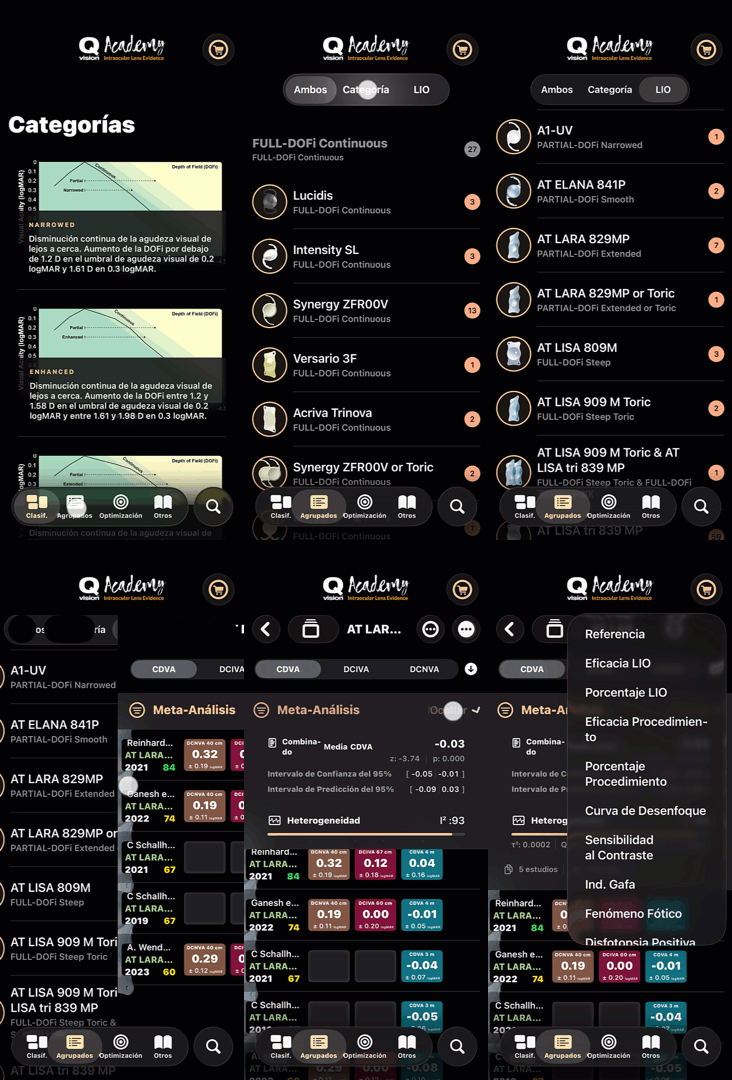 | How to access this viewThis view is accessed by tapping the Grouped icon in the bottom navigation bar of the app. From there, users can choose to explore the evidence either by Functional Category or by Intraocular Lens (IOL). What can be seenThis view presents a two-step navigation structure. In the first step, reports are grouped either by Functional Classification category or by IOL model, depending on the selected option. Selecting one of these groups leads to the second step, which displays the Confirmatory Report List containing all relevant reports for the chosen category or IOL. In this configuration, reports may include different IOLs or categories, allowing broader comparison and exploration of outcome variability. |
|---|
3.2.1. When to use Two-Step Evidence Grouping
This view is recommended when the objective is to:
Compare different IOLs within the same functional category, understanding similarities and differences in reported outcomes.
Explore the overall performance profile of a single IOL, accepting that results may come from studies with different categories or procedural strategies.
Identify patterns of variability driven by study design, population, or procedural differences, rather than removing them.
3.2.2. Two-Step Navigation Logic
In this view, reports are grouped using one of two alternative paths:
3.2.2.1. Grouping by Functional Category
When grouping by Functional Category, all reports belonging to the same category are displayed together. This allows comparison of different IOL models that share a similar mean expected functional performance. In this configuration:
IOLs can be mixed.
Reports may involve different surgical strategies or procedural variations.
Differences observed across studies may reflect both IOL-specific effects and procedural or population-related variability.
This pathway is particularly useful for understanding how lenses classified within the same functional group may still produce different outcomes in practice.
3.2.2.2. Grouping by Intraocular Lens (IOL)
When grouping by IOL, all available reports for a specific lens are displayed together, regardless of functional category or procedural context. In this configuration:
Functional categories may be mixed.
Procedural variations, such as target refraction or patient selection, are preserved.
Observed differences highlight how outcomes for the same IOL change under different clinical conditions.
This pathway is especially helpful to appreciate the range of reported outcomes for a given lens and to identify potential sources of variability.
3.2.3. Report List and Outcomes
In both two-step configurations, navigation ultimately leads to the Confirmatory Report List, where users can:
The Confirmatory Report list, where individual studies are presented and can be sorted by recency, score, or year. You can read more about working with this in articles 2.2 and 2.3.
A clinical outcome selector, allowing users to choose which outcome to visualize and compare (e.g., IOL efficacy, procedure efficacy, defocus curve, contrast sensitivity, or patient-reported outcomes).
Access to the meta-analysis option, when available, to synthesize evidence across studies.
The individual Confirmatory Report, where detailed study information and results are presented. You can know more about reading Confirmatory Reports in article 1.3.