1.1. Knowledge Overview
1.1.1. Studies versus Reports
A Study refers to the original scientific article or paper published by the authors, in which one or more intraocular lenses (IOLs) are investigated and clinical data are reported. In contrast, a Report represents the set of results associated with a specific IOL within that study. A single study may therefore generate multiple reports when it evaluates more than one IOL, as occurs in comparative studies, randomized clinical trials, or head-to-head analyses. For this reason, within the IOLEvidence application, the same study reference may appear more than once in the list: each occurrence corresponds to a different report linked to a different IOL analyzed in that study.
1.1.2. What are Confirmatory Reports?
Confirmatory Reports are reports derived from studies that present clinical outcomes in a Standardized and Homogeneous format. They typically include quantitative results such as visual acuity at different distances, reported both monocularly and binocularly, defocus curves, contrast sensitivity, and other predefined clinical endpoints.
These reports are called Confirmatory Reports because their purpose is to confirm whether the observed clinical results match the expected behavior of a given Functional Classification category. Since a single IOL may be evaluated in multiple studies, each with its own methodological characteristics and potential sources of bias, the same IOL may show results that align more closely with one functional category or another, especially among neighboring categories. As the number of standardized reports increases, their results can be Meta-Analyzed with IOLEvidence at a population level, allowing variability to be averaged out and leading to a robust confirmation of the Functional Classification of a specific IOL.
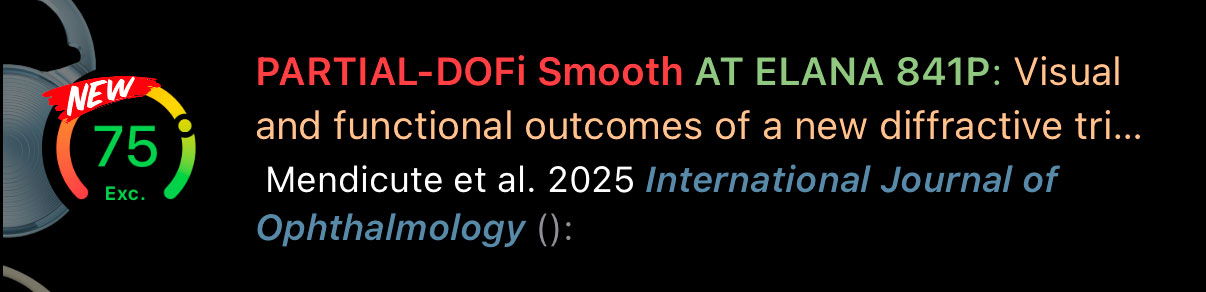
In the Confirmatory Reports list, each study entry displays (See the color in the previous image):
Functional Classification Category (Red)
Intraocular Lens Model (Green)
Study Title (Orange)
First Author (followed by et al. when applicable) (White)
Journal Name (Blue)
Year of Publication (White next to First Author)
A Report Quality Score, shown on the left side, based on:
Reported outcomes
Reported confounders
Study methodology
Overall robustness of the evidence
1.1.3. What are Optimization Reports?
Optimization Reports are reports focused on explaining why clinical results may vary, rather than on confirming classification. They are designed to explore the influence of confounding factors that can modify the functional behavior of an IOL. This variability may arise not only from study methodology, but also from characteristics of the studied subjects, such as pupil diameter, age, biometric parameters, ocular anatomy, or higher-order aberrations. Optimization Reports help clinicians understand under which conditions and in which types of patients a given IOL may perform differently. As a result, these reports support personalization and clinical optimization, showing that an IOL may exhibit different functional behavior depending on patient-specific factors.
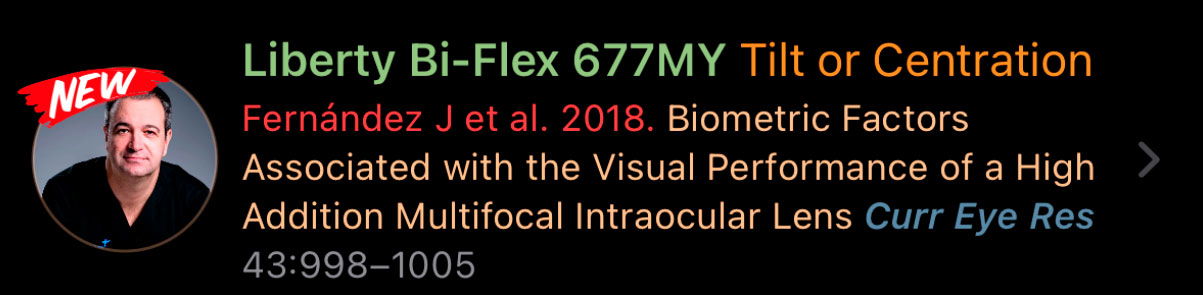
In the Optimization Report list, each study entry displays (See the color in the previous image):
Intraocular Lens Model (Green)
Study Topic (Orange)
First Author (followed by et al. when applicable) (Red)
Year of Publication (Red next to First Author)
Title (Light Orange)
Journal Name (Blue)
First Author photo.
1.1.4. Other Knowledge
In addition to its core content based on IOL studies, whether Confirmation Reports or Optimization Reports, the IOLEvidence application also includes an Other Knowledge section. This section is designed to provide users with complementary educational resources that go beyond formal clinical studies.
In Other Knowledge, users can find content such as:
Educational articles
Practical clinical tips
Short explanatory videos
These materials are intended to support continuous learning, clarify concepts related to IOL selection and interpretation of evidence, and offer practical insights that may not be presented in scientific studies.